World Vegan Day: a diet with reduced meat consumption could prevent millions of premature deaths and cut emissions by 15%
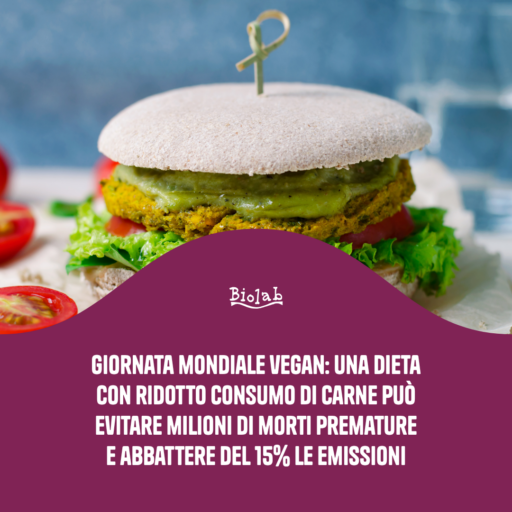
World Vegan Day: a diet with reduced meat consumption could prevent millions of premature deaths and cut emissions by 15%.
But Europe is pushing back. Biolab: “The EU is introducing irrational measures that hinder the green transition and harm a fast-growing Made in Italy sector.”
October 30, 2025 – The global adoption of the Planetary Health Diet could reduce the global risk of premature death by 27%, preventing up to 15 million deaths per year, while significantly lowering the risk of chronic diseases such as cancer, type 2 diabetes and cardiovascular conditions. Moreover, the diet would have a strong environmental impact, bringing down carbon emissions linked to food production by over 15% compared to 2020. These are the findings of the 2025 EAT-Lancet Commission Report, presented as the most comprehensive global scientific assessment of food systems to date.
The Commission, which brings together experts in agriculture, health, economics, social justice, nutrition and environmental sciences from 17 countries, aims to inform the public and policymakers on how to transform food systems in order to ensure a healthy and sustainable diet for the planet — one that is compatible with a growing population estimated to reach 9.6 billion by 2050.
The healthy diet recommended by the Commission is based on whole grains, fruit and vegetables, nuts and legumes, with a very moderate intake of animal protein. To achieve this on a global scale, the EAT-Lancet Commission estimates that legume production would need to increase by up to 190% and vegetable production by 42–48%, while animal production would need to decrease by 22–27%.
These are changes that Italian consumers have been embracing for some time. According to the latest report published by Eurispes last May, 9.5% of the population aged 18 and over does not eat meat, with vegans accounting for 2.7% of the population — a slight increase of 0.6% compared to 2024. These figures have remained broadly stable over the past year, but have quadrupled between 2014 and 2024. While these remain niche choices, the trend deserves serious attention from policymakers and the public alike, and sits within a global context of steadily growing numbers of people choosing alternative proteins over animal ones.
For all these reasons, the plant-based sector has seen a sharp rise in recent years, and in Italy it has become one of the flagships of Made in Italy, also driving the agricultural supply chain — often organic — that forms the raw material base for production.
In Europe, where the sector generates €6 billion in revenue, Italy ranks third for production and consumption behind Germany and the United Kingdom, with a market worth around €640 million — up 16.4% compared to 2022 and 7.6% compared to 2023.
It is no coincidence that Biolab, one of Italy’s leading plant-based companies, had a turnover of €8 million just eight years ago and is now closing 2026 at €26 million, with 170 employees.
“We firmly believe,” says Massimo Santinelli, founder and CEO of Biolab, “that producing plant-based meat and fish alternatives and encouraging consumers to choose these products can represent a genuine turning point in the fight against climate change, soil biodiversity loss and the depletion of our seas.”
And yet, European policymakers are choosing to go against the grain of growing public awareness, once again placing serious obstacles in the way of the plant-based sector — this time by banning the use of meat-related names on product labels. A measure pushed by the centre-right and approved by the majority of the EU Parliament just days ago. From 2028, producers will no longer be able to label their plant-based foods as “veg burger”, “soy hamburger” or “lentil sausage.”
“It is entirely irrational on Europe’s part,” adds Santinelli, “to want to damage a sector that represents, today, the only viable alternative to animal protein consumption. It is clear that this measure hides, behind the proclaimed defence of a consumer supposedly unable to tell a meat burger from a plant-based one, the real objective of protecting an increasingly embattled meat lobby. Policymakers,” Santinelli concludes, “instead of discouraging the consumption of plant proteins, should be encouraging their production and helping to inform consumers, steering them ever more towards choices aligned with the demands of a real ecological transition that can no longer be postponed.”